SW-IN / SW-OUT Explained: Why Universal Wiring Matters in Mixed Fleets
May 20, 2026
You open the back of a skill game/gaming machine at 10 PM. You don't see a clean setup. Instead, you stare at a bird’s nest of electrical tape. There are wire nuts and "vampire" clips everywhere. They tap into the machine's power supply in a messy way
Then you head to the next stop. You need to service a modern ATM cabinet. You find a completely different DIY alarm. It uses a 9V battery and thin speaker wire. This speaker wire is brittle. This inconsistency is a headache for technicians. It is also a massive liability for your business.
Every machine on your route has a different security "flavor." This makes troubleshooting a guessing game. The thing is, professional route management relies on predictability. Your security isn't reliable if it isn't standardized.
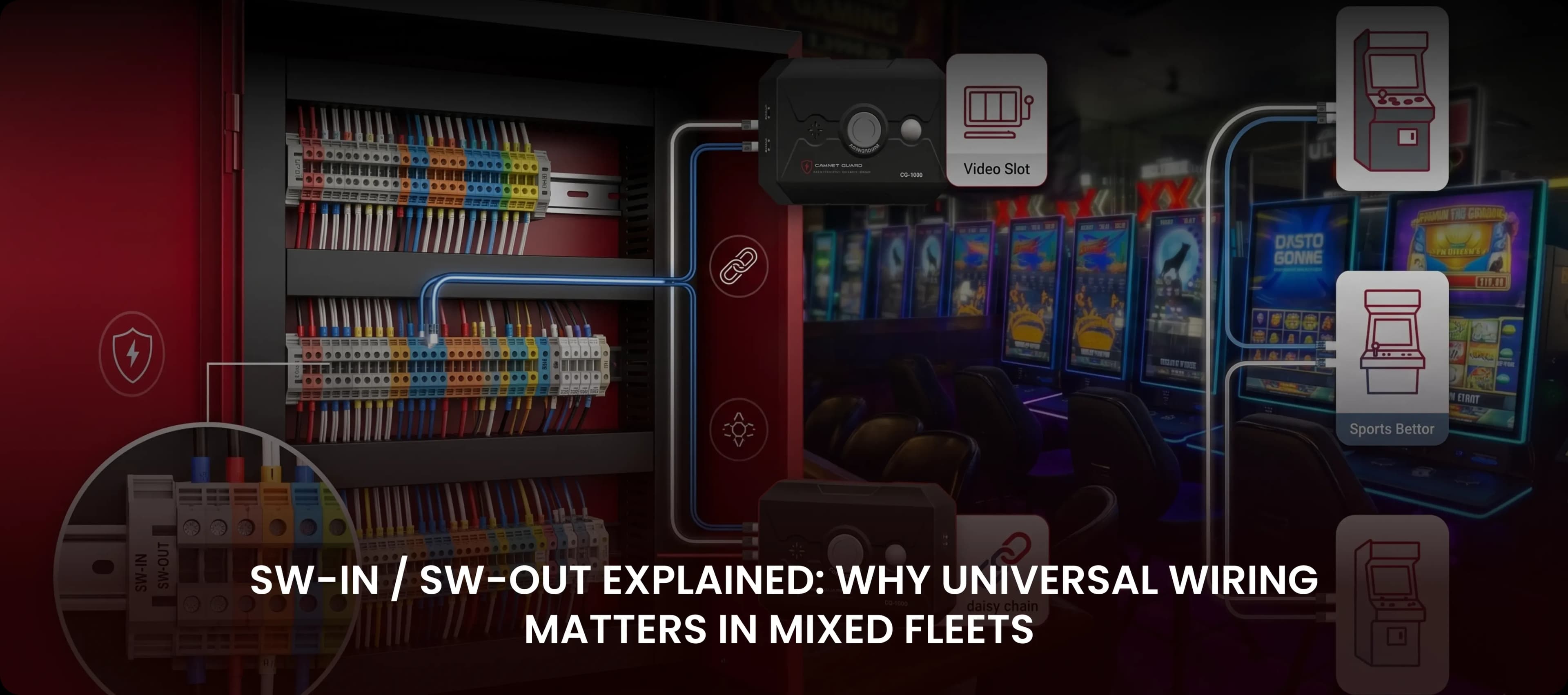
We designed the CG-1000 with a specific architecture. It uses the universal wiring harness logic of SW-IN and SW-OUT. Understanding this daisy-chain system is the first step. You can move from "firefighting" to managing a professional fleet.
TL;DR: Scaling Route Security with Universal Standards
- Fleet Standardization: One wiring logic works for ATMs, VGTs, and skill games.
- Daisy Chain Terminals: SW-IN / SW-OUT makes multi-door expansion easy.
- Voltage Versatility: 12–24V AC/DC support handles mixed power.
- Reliability: A standalone, wired system provides 24/7 protection.
- Internal Access Control: Clear labels reduce technician errors.
The Mixed Fleet Headache: Different Machines, Different Problems
Most operators have a mixed fleet. You might have ten PA skill games in one shop. You might have three vending machines in another. You also have ATM cabinets at gas stations and bars.
The Danger of One-Off Security Hacks
Each machine has different internal parts. They have different door counts. They also have different power profiles. This is a problem. Vending Machine Theft Prevention requires a clean approach.
The danger of "one-off" fixes is simple. They are rarely documented. A tech leaves the company. The "secret" wiring of that cabinet goes with them. A universal wiring harness approach changes that. You are installing a "universal translator" for security.
Driving Route Efficiency
The wiring logic stays the same. It doesn't matter if the machine is new or old. This fleet standardization is a secret. It leads to route profitability. It removes the learning curve for new hires. It ensures every machine has high-trust defense. Arcade machine security works best when it is standardized.
Decoding the Logic: What is SW-IN / SW-OUT?
In this industry, "SW" stands for Switch. The SW-IN and SW-OUT ports are entry and exit points. They form a series circuit. This is the gold standard for unauthorized access detection.
The Supervised Loop Concept
Here is how the logic works:
- Electricity leaves the CG-1000 at the SW-OUT terminal.
- It travels through the first door switch.
- It goes to the next switch, like the coin box.
- It returns to the CG-1000 at the SW-IN terminal.
The 100+ dB siren triggers if the loop breaks. This happens if a door is pried. It also happens if a wire is cut. The system is wired. There is no "jamming" the signal. It is a physical reality. The loop is either closed or it is screaming.
Labeling for Field Success
The CG-1000 has clear terminal block labels. A tech does not have to trace wires in the dark. They just look for the labeled ports. This makes internal access control much cleaner. Using iButton access control makes this even better.
Multi-Door Expansion Without the Spaghetti
Gaming machines often have many access points. You have a main door. You also have a bill validator door and a coin mech.
Simplified Power Management
DIY kits are messy. You try to cram many wires into one terminal. This leads to loose connections. It causes "ghost" triggers. To avoid this, you need a maintenance strategy.
The CG-1000 acts as a power distribution cabinet for your sensors. Use the daisy chain terminals. You can protect up to three doors on a single unit. You don't add extra wires to the main board. Why spring-cage terminals are the standard is clear here. They hold the wire tight.
Securing the High-Value Asset
This multi-door expansion secures every inch. Look at a gas station ATM. You can chain the top cabinet and the vault door. The siren hits if either opens. This is a key part of ATM Theft Prevention. It belongs in your standard team SOP. A trained technician can integrate this loop cleanly during a standard location swap.
Why 12–24V AC/DC is the Operator's Best Friend
Voltage is a silent killer. Skill games often run on 12V DC. Many VGTs use a 24V AC transformer. Some alarms only handle one type. This forces you to carry extra parts.
Filtering Field Noise
The CG-1000 works in 12–24V AC/DC environments. You can tap into almost any machine power. This leads to false alarm reduction. Cheap alarms struggle with "dirty" power. This causes spikes. Those spikes trigger the siren for no reason.
Industrial Grade Regulation
Our hardware filters out that noise. It provides long-term reliability. The power might fluctuate. The alarm stays quiet. The 100+ dB siren only fires when a door moves.
Professionalizing the Route: Beyond the Siren
Your route is an investment. A machine might be down for a "fix." That machine isn't making money. You need to focus on the machine downtime cost.
Use a standalone system with a tamper-resistant enclosure. It sends a message. It tells thieves the machine is managed. It tells employees the same thing. Visual alarms add to this deterrent.
Standardization helps you run a tighter ship. It reduces technician safety risks. Your after-hours security becomes a constant. This is operator-grade hardware.
Next Steps for Route Operators
Standardizing a fleet takes time. It starts with the right hardware. Move away from messy hacks. A quick, standardized installation performed by a trained technician keeps your hardware secure and your team moving.
Are you tired of "ghost" alarms? Are you tired of the bird’s nest of wires? Look at the CG-1000. It is a no-nonsense tool. It was built for the realities of the American route.
Protect your revenue. Use a system built by operators.