
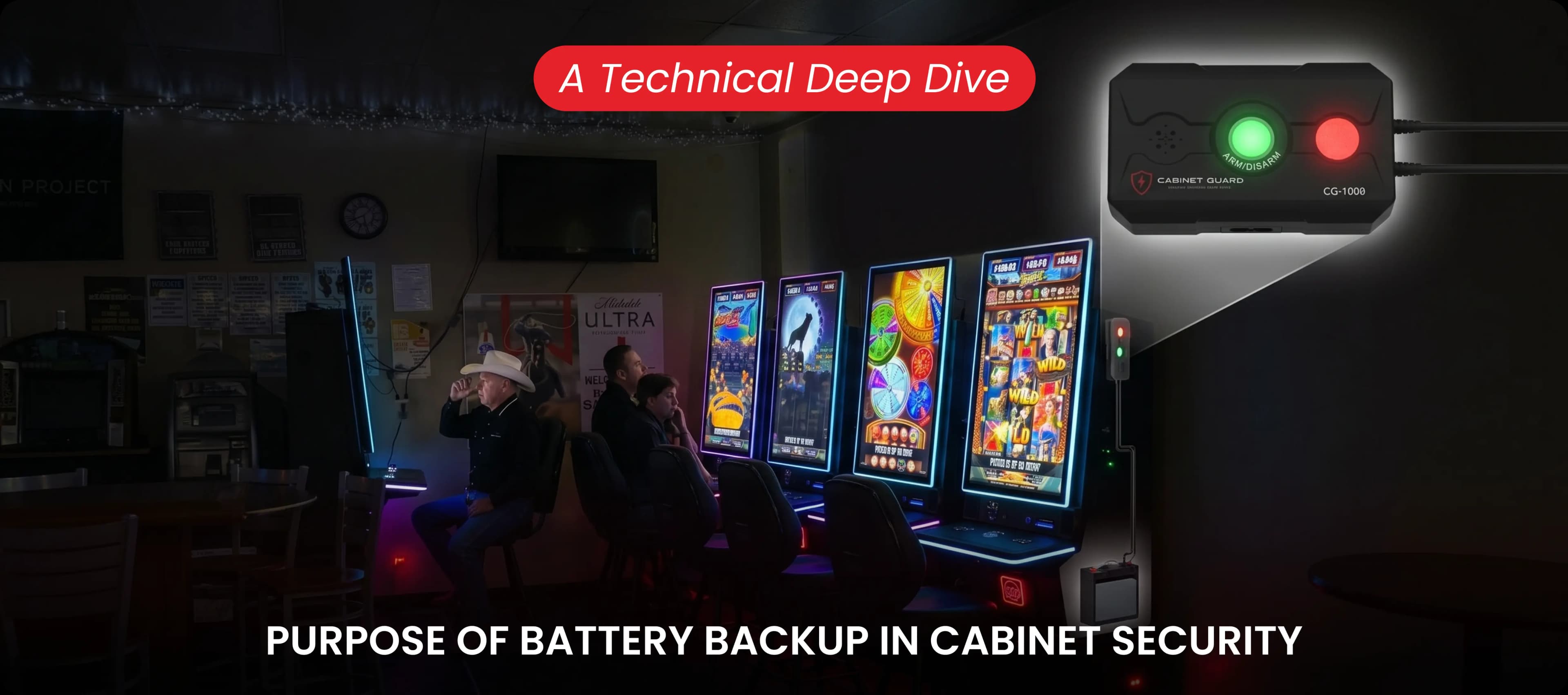
Purpose of Battery Backup in Cabinet Security: A Technical Deep Dive
May 11, 2026
Imagine it’s 2 AM at a remote truck stop. The lights flicker and die during a storm, or maybe a "customer" reaches behind your machine and yanks the power cord. In that instant, your machine is just a box of cash sitting in the dark. If you don't have a battery backup for your alarm system, your security just vanished along with the lights.
For route operators, power isn't a guarantee. It’s a variable. Whether it’s a localized blackout, a tripped breaker, or a deliberate attempt to disable security, your machines need to be self-sufficient. This guide breaks down the technical "why" behind battery backups and how they keep your route profitable when the grid fails.
TL;DR: Battery Backup for Alarm System at a Glance
- Local Deterrence: A battery backup alarm ensures the 100+ dB siren screams even if the main power is cut.
- Continuous Logic: Keeps iButton access control active so you can still service the machine during a blackout.
- Theft Prevention: Stops thieves from using "the power cut trick" to bypass your sensors.
- Lifespan: Understanding alarm battery lifespan prevents the dreaded "quiet failure" of your security.
The Field Reality of Power Failure
Most security breaches don't start with a pry bar. They start with a power cut. A thief knows that most off-the-shelf alarms rely entirely on the location’s electricity. They pull the plug, wait 60 secs for any capacitors to drain, and then get to work. It’s a simple, effective tactic that bypasses cheap hardware every single time.
Keeping the Siren Alive
When the main 12-24V AC/DC line goes dead, the battery backup takes over instantly. This isn't just about keeping internal system logic alive. It’s about having enough "juice" to drive a massive 100+ dB siren and a strobe light.
Without that secondary power source, your machine is a sitting duck. Just a wide-open target.
It makes sense to get these fail-safes in place before the breach happens, not after you're staring at a ruined cabinet and a missing cash box.
Understanding the Battery Backup for Alarm System
What is a Battery Backup Alarm?
At its core, a battery backup alarm is a security controller equipped with a charging circuit and a link to a secondary DC power source.
In professional-grade hardware like the CG-1000, this is usually a built-in power cell that stays topped off while the machine is plugged in. The moment the primary power is interrupted, the system switches to the battery without a millisecond of downtime.
The Purpose: Why Redundant Power is Non-Negotiable
The main purpose isn't just "uptime"; it’s the integrity of the trigger. A security system needs to maintain its "brain" and its "voice." The brain is the logic board that monitors the door switches. The voice is the siren. If the power fails, a backup power for the alarm system ensures that opening the door still results in a deafening alert that drives the intruder away.
Why a Security Alarm Backup Battery is Your Real Defense
Internal Theft Prevention
It’s a hard truth in the route business: sometimes the threat comes from within. A dishonest employee or location staffer might "accidentally" unplug a machine to see if the alarm goes off. If it stays silent, they know they have a window of opportunity later that night.
Having a dedicated security alarm backup battery means the alarm is always "hot." It doesn't matter if the machine is moved, unplugged, or the breaker is flipped; the security remains active. This is a huge part of theft prevention that many operators overlook.
Local Deterrence and High-Draw Components
The thing is, making a lot of noise requires a lot of energy. A 100+ dB siren pulls a significant amount of current. Cheap, low-capacity batteries might keep a sensor alive, but they’ll die the moment the siren tries to kick in. You need an alarm battery designed to handle that sudden high-amp draw. This ensures the siren doesn't just "chirp" and die; it screams until the battery is exhausted or an operator uses their key.
Maintenance & Longevity: What Operators Need to Know
How Long Do Alarm Batteries Last?
This is the most common question we get from technicians. Usually, a high-quality lead-acid or lithium-based backup battery will last between 3-5 years. However, the environment matters. If you have an ATM in a hot Texas vestibule or a skill game in a damp Pennsylvania warehouse, that alarm battery's lifespan can drop.
Heat is the number one killer of batteries, causing the chemistry to degrade faster than it would in a climate-controlled arcade.
Understanding System Lifespan
You shouldn't have to babysit your security hardware. Industrial-grade backup batteries are built directly into the circuit to run for years without any field maintenance. There are no loose parts to swap out or keep track of on the route.
The system handles itself while your machine runs. A good setup gives you a solid one-year factory warranty to cover any early component issues right out of the gate. From there, the internal power cell is built to quietly pull shifts for three to five years before the entire sealed unit naturally hits the end of its life cycle. You install it once, close the door, and let it work.
Integrating Backup Power into Your Route Management
Vending Machine Protection
Vending machines are often isolated. They sit in break rooms or outside storefronts, where they are easily unplugged. Effective vending machine protection relies almost entirely on that backup power. Because these machines are large and often have vibration-heavy compressors, you need a tamper-resistant enclosure to ensure nothing vibrates loose over time.
Avoiding Controller Glitches
Adding a battery doesn't just help during a theft. It keeps your security hardware stable. It acts as a buffer against "brownout" or power fluctuations that can cause some digital alarms to reset or glitch.
By maintaining a steady DC voltage to the controller, you cut down on the false alarms and interference issues that often plague unreliable wireless hardware.
The Role of iButton Access Control
Even without the main power, you still need to get into your machine. A battery backup for an alarm system ensures that your iButton access control reader still works. Imagine arriving at a dark location during a power outage only to find you can't open your own machine because the electronic lock or alarm bypass doesn't have the power to read your key. That’s a service nightmare that a simple backup prevents.
Conclusion: Building a Fail-Safe Route
Security isn't about one single lock; it’s about a chain of reliable components. The battery backup is the link that holds the whole system together when things go wrong. Whether you are protecting a high-earning skill gaming machine or a standalone ATM, ensuring you have operator-grade hardware with a solid power plan is the only way to sleep soundly.
Stop looking at the battery as an optional accessory. It is a fundamental part of your scalable protection strategy. When the lights go out, your siren should be the only thing the thief hears.
Protect Your Route Today
If your current machines are one pulled plug away from being wide open, it’s time to upgrade. The CG-1000 was built by operators who’ve dealt with the aftermath of power-cut thefts. We designed it to be a no-nonsense, field-tested solution that keeps your machines secure, power or no power. Check out the full specs and see how easy it is to add stability to your route.
For more technical guides on route maintenance, you can browse our full articles listing of operator resources.