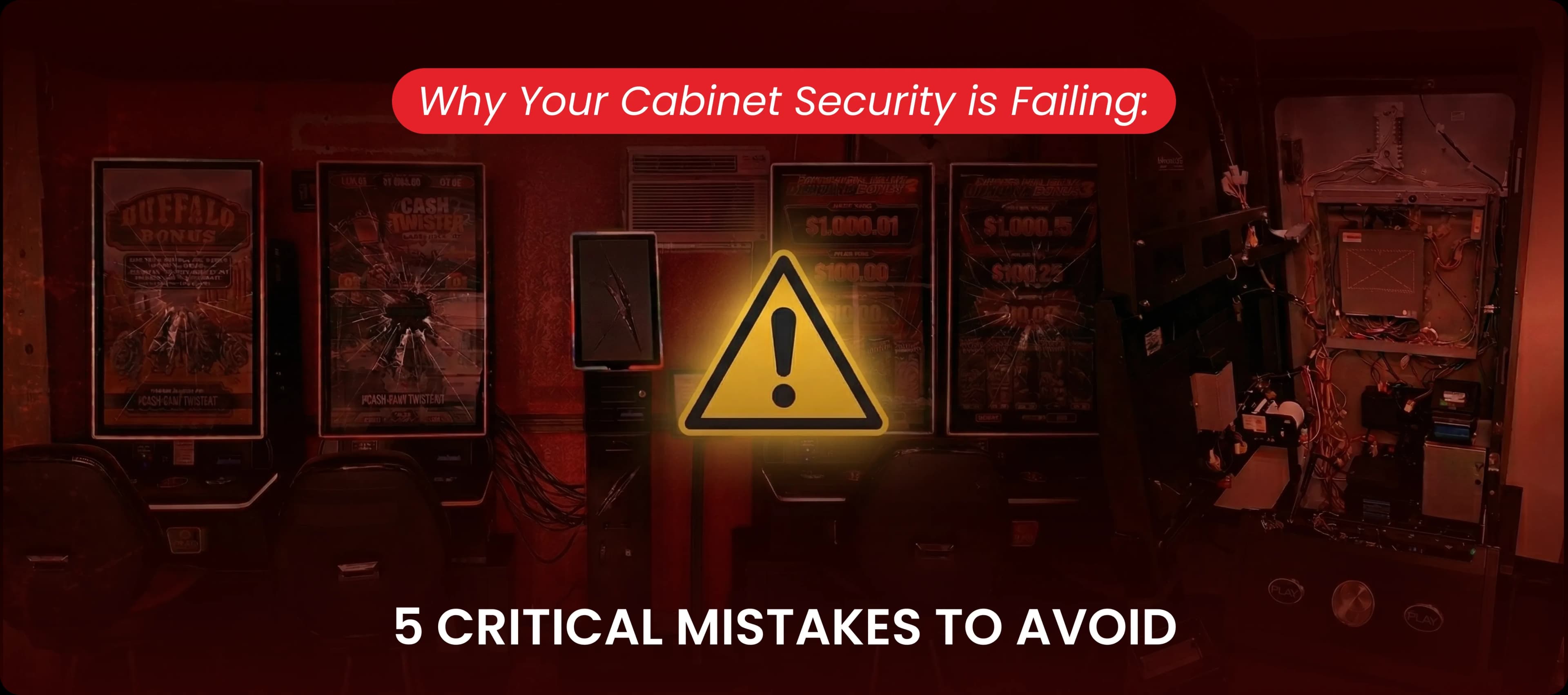
Why Your Cabinet Security is Failing: 5 Critical Mistakes to Avoid
Mar 29, 2026
In the route business, whether you’re pulling cash from a vending machine, managing a bank of skill games in Pennsylvania, or maintaining an ATM in a Texas convenience store, security usually follows a predictable cycle. You buy the machine, realize the factory lock is insufficient, and spend the next three years trying to "harden" it with aftermarket parts.
Most operators don't realize their security is failing until a technician arrives to find a pry-marked door and an empty bill validator. The mistake isn't a lack of effort; it's a lack of strategy. Relying on "passive" security like puck locks and steel plates only buys a thief time. Without active detection, you aren't stopping a theft; you’re just making the thief bring a bigger crowbar.
After consulting with operators and technicians across the US, we’ve identified the recurring technical errors that compromise route profitability. Here are the five most common mistakes in securing gaming cabinets, ATMs, and vending machines, and how to fix them before the next truck roll.
TL;DR: The Operator’s Security Audit
- Active vs. Passive: Physical locks aren't enough; you need a 100+dB siren to create immediate social pressure.
- Switch Choice: In high-vibration environments, the magnetic switch vs mechanical switch debate is settled by reliability.
- Power Standards: Avoid "dirty" power tapping; use a system that supports 12–24V AC/DC natively.
- Key Management: Replace physical master keys with iButton access control to eliminate the risk of lost rings.
- Standardization: A universal cabinet tamper alarm like the CG-1000 works across ATMs, VGTs, and amusements.
Mistake #1: Relying on "Silent" Physical Hardening
The most common instinct is to make the box "harder." Operators bolt on heavy steel bars, add puck locks, and weld on reinforcement plates. While these are great deterrents for the casual vandal, they do nothing to stop a determined thief with a 36-inch pry bar.
If a thief can work on a cabinet in a quiet corner for ten minutes, they will get in. The mistake is assuming the lock is the end-all, be-all. When you compare traditional cabinet locks vs modern cabinet guard systems, the difference is active detection.
The Fix: You need a high-intensity 100+dB siren to change the math for a thief. The moment that the door frame is breached, the environment becomes hostile. In a bar or convenience store, a 100-decibel alert draws immediate attention and moves the thief from "how much can I get?" to "how fast can I leave?"
Mistake #2: Choosing the Wrong Sensor for the Environment
When operators decide to install a cabinet tamper alarm, they often grab the cheapest magnetic reed switches from a security catalog. While these are fine for an office, they are a liability on a route.
The magnetic switch vs mechanical switch debate is a frequent point of failure. Magnetic sensors require precise alignment. Over time, heavy vending doors sag, and ATM hinges wear down. If that magnet moves just 3mm out of alignment, you get a false alarm at 2:00 AM.
The Fix: Use a mechanical plunger or roller-plunger switch. These are far more forgiving of door gap fluctuations. Understanding what actually makes a cabinet alarm operator-grade means choosing components that survive the physical realities of high-traffic locations.
Mistake #3: "Duct Tape" Wiring and Dirty Power Tapping
We see it on every route: a security device tapped into a 5V logic rail or "piggybacked" onto a bill validator’s power harness. This is a recipe for equipment failure. Tapping into sensitive logic lines can cause board resets or "phantom" errors, contributing heavily to the true cost of skill game downtime.
The Fix: Standardize on hardware with a wide voltage tolerance. The Cabinet Guard CG-1000 was designed for the field, supporting 12–24V AC/DC power. Combined with spring cage terminals, which resist vibration better than traditional screw terminals, you get a solid electrical connection that lasts. This technical precision is part of why standardization is the secret to route profitability.
Mistake #4: The "Master Key" Vulnerability
In many markets, technicians carry a "ring of power", a massive set of keys for every cabinet on the route. If a tech loses that ring, your entire physical security infrastructure is compromised. Re-keying 50+ machines is a logistical and financial nightmare.
The Fix: Move toward digital credentials. Implementing iButton access control allows you to give each technician a unique digital "key." These keys are harder to duplicate and allow for a dedicated "service mode." This is a critical step when choosing scalable protection for growing game route businesses, as it allows you to revoke access instantly if a key is lost.
Mistake #5: Using Consumer-Grade IoT in a Metal Box
Many operators are tempted by "smart" home sensors or Wi-Fi alarms. This is a mistake because most gaming and ATM cabinets are thick metal boxes that act as Faraday cages, blocking Wi-Fi signals. Furthermore, wireless signals can be jammed.
The Fix: Stay hardwired. A hardwired system inside a tamper-resistant enclosure doesn't care about signal strength. If you are looking at how to choose the right cabinet security system for your route, prioritize local, wired reliability over flashy but fragile mobile apps.
The Impact: Reducing Truck Rolls and Protecting Profit
Every time a technician drives out for a false alarm, you lose money. Between fuel, labor, and the opportunity cost of missed maintenance, "cheap" security becomes expensive. By following a proper cabinet tamper alarm wiring guide, you ensure false alarm reduction and reduce truck rolls.
Whether you are installing a vending machine anti-theft device or securing a high-value VGT, the principles remain the same: active deterrence, rugged hardware, and simple, wired reliability. If you notice the warning signs, don't wait for a breach to act. Effective security for vending machines and amusement machines isn't about the biggest lock; it's about the smartest system.