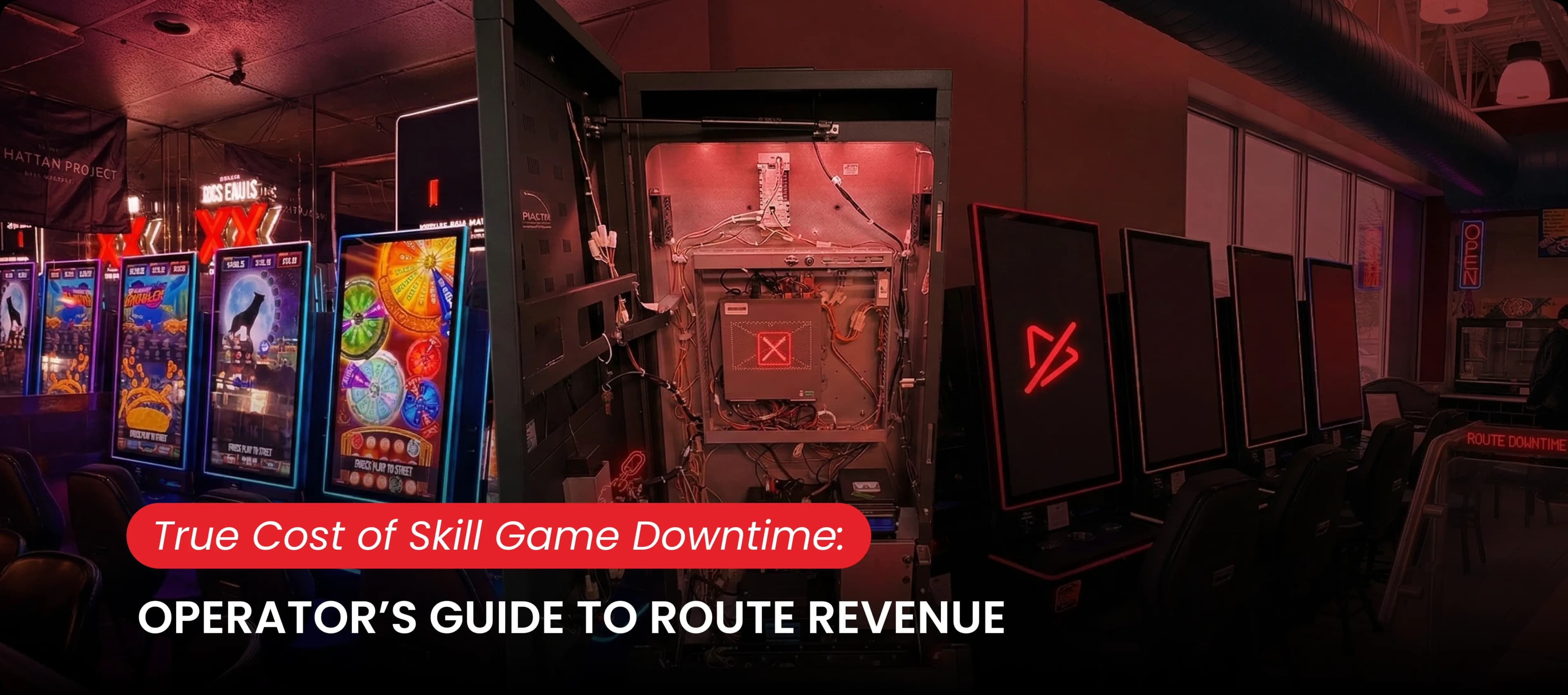
True Cost of Skill Game Downtime: Operator’s Guide to Route Revenue
Mar 11, 2026
When a skill game machine or video gaming terminal stops accepting bills, the financial bleed starts immediately. Most operators calculate the cost of a security breach by looking at the damage to the cabinet and the amount of cash missing from the vault. While those numbers are visible, they represent only a fraction of the total loss.
Many of the insights in this article come from conversations with route operators and technicians who manage dozens of skill and amusement machines across multiple locations. They know that the "true" cost of skill game downtime is a compounding equation of labor, lost opportunity, and location-owner friction.
Key Takeaways: Protecting Your Route Uptime
- The $10k Threshold: Between physical repairs, emergency labor, and lost revenue, a single cabinet breach is a major capital hit.
- Invisible Losses: A machine outage during peak hours often costs more in lost play than the actual cash stolen during a cabinet breach.
- Labor Drain: Every emergency truck roll for a cabinet intrusion pulls a technician away from revenue-generating maintenance.
- Location Trust: Frequent machine downtime damages your reputation with establishment owners and risks your contract.
- Active Defense: Hardwired security prevents the physical damage that leads to long-term gaming machine uptime issues.
The Immediate Revenue Gap
In states with high-volume play, such as Pennsylvania orTexas, a single machine might see peak traffic between Friday night and Sunday evening. If a skill machine is tampered with or suffers a lockout on a Friday afternoon and stays down until a technician can arrive on Monday, that's 60+ hours of zero revenue.
In a high-traffic location, that lost window often exceeds the total value of the cash that was actually in the cash box at the time of the breach. You aren't just losing the money they took; you're losing the money the next 200 players were going to give you. Understanding how cabinet alarms prevent unauthorized access is the first step in closing this revenue gap and maintaining route uptime.
The Hidden Logistics Drain
Every time a technician has to deviate from a scheduled collection route to handle a machine downtime call, the efficiency of the entire route drops.
- The Truck Roll: Gas, vehicle wear, and insurance aren't getting cheaper. A 40-mile round trip for a single repair is a high-overhead event.
- Specialized Labor: Skilled technicians are hard to find. When they spend four hours driving and fixing a pried tamper-resistant enclosure, they aren't performing the preventative maintenance that ensures machine availability elsewhere.
- Parts Sourcing: Replacing a damaged bill validator or a specialized gaming machine door isn't always a 24-hour turnaround. A machine waiting for parts is a "dead asset" taking up floor space.
Many operators are realizing that traditional cabinet locks vs modern cabinet guard systems is no longer a fair comparison when you factor in these logistics costs.
Location Owner Friction and Trust
The relationship between an operator and a location owner is built on the machine’s ability to perform. A skill gaming machine that sits dark in the corner of a convenience store is an eyesore to the proprietor.
If a location owner has to call you three times to report a cabinet security failure, their trust in your equipment diminishes. They start looking at the square footage that the machine occupies and wondering if a different vendor would be more reliable. A machine outage doesn't just hurt your wallet; it hurts your contract longevity.
Why Mechanical Security Isn't Enough
Standard locks are a baseline, not a solution. In most skill-based gaming environments, a determined person with a pry bar can bypass a physical lock in under 45 seconds. The goal of a cabinet alarm system isn't just to make noise; it’s to prevent the "Downtime Cycle" from starting.
By using hardware like the Cabinet Guard CG-1000, which relies on 12–24V hardwired power and local deterrence, you aren't waiting for a Wi-Fi alert that may never come. You are stopping the cabinet intrusion before it causes the structural damage that leads to weeks of low machine availability. The iButton access control ensures that your own staff can service the machine without adding to the technical debt of the route. If you're unsure of your current setup, look for the 5 warning signs it's time to upgrade your cabinet security.
The "Dead Machine" Math
Most operators undercount their losses. Here is a realistic breakdown of a single cabinet breach:
- Stolen Cash: $500 – $2,000
- Physical Damage (Door, Logic Board, Validator): $600 – $1,500
- Lost Revenue (Peak Window Outage): $1,200 – $3,500
- Labor & Logistics (Emergency Tech & Travel): $400 – $800
- Reputation Cost (Location Friction): Hard to quantify, but translates to future contract risk.
- Total Loss Range: $4,000 – $10,000+
The hardware cost to prevent this scenario is a one-time expense. The cost of skill game downtime is a recurring tax on your business every time a machine is breached. Knowing how to choose the right cabinet security system can eliminate this "tax" entirely.
The Operational Bottom Line
Gaming machine uptime is the only metric that truly tracks the health of a route. Whether you are running skill machines for sale or managing a long-term route of video gaming terminals, the goal is to keep the "Open" sign on. Every hour a machine is dark is an hour your overhead is eating your profit.
Reliable, hardwired security isn't a luxury for the skill gaming machines in your fleet, it’s an insurance policy against the compounding costs of being offline. Solving cabinet tampering in skill games is the most direct way to protect your bottom line.