Traditional Cabinet Locks vs. Modern Cabinet Guard Systems
Feb 11, 2026
You inherited a route with forty machines and no real idea who still has a copy of which key. Three technicians have come and gone in the last two years. One vendor rekeyed half the cabinets after a bad hire; the other half still run the original barrel that's been in the door since the location opened. Nobody wrote any of this down.
That's the actual case for cabinet lock replacement, and it has nothing to do with how many minutes a pry bar needs. It's about whether you can answer, with certainty, who can open your cabinets right now. Most operators can't answer that for their whole route, and that gap is the real security problem, not the metal in the door.
TL;DR: What to Know Before You Replace a Cabinet Lock
- The Real Problem Isn't the Lock's Strength: It's that nobody can account for every key that's ever been cut for it.
- Key Control Breaks Down Fast: Technician turnover, vendor changes, and lost keys all create copies you can't track.
- Replacement Should Be Sequenced, Not Random: High-turnover and high-cash locations belong at the front of the line.
- A Door-Contact Alarm Solves a Different Problem: It fires the instant a door opens without authorization, regardless of who has a key.
- This Applies Across a Mixed Route: Vending, ATM, and skill game cabinets each have their own wiring quirks, but the key control problem looks the same everywhere.
Why a Cabinet Lock's Security Ends at the Keyring
Only the right people are supposed to hold the right key. That's the entire security model a mechanical lock runs on, and every person who's ever been handed a copy, and never had it collected back, is a hole in it. Most routes have more of those holes than anyone's counted, which is part of why locks alone struggle to keep up with a growing route.
The Keys You Can't Account For
Think about a driver who left the company eight months ago. His keyring is probably still sitting in a truck glovebox somewhere, and nobody asked for it back. Add a locksmith who cut a spare "just in case" during an install years ago. Add a location owner who insisted on holding a set for emergencies and never gave it up. None of these people are doing anything wrong. The thing is, a cabinet lock doesn't check whether someone left the company two years ago before it turns.
A lock isn't a security decision.
It's a trust decision.
And trust decisions decay the moment you can't remember who you extended them to, which for most routes is somewhere around year two.
What a Lock Actually Buys You (and What It Doesn't)
A lock slows someone down. That's genuinely useful against an opportunist with no tools and no time. It does nothing against someone who already has a valid key, and it does nothing to tell you a break-in happened until you notice it yourself.
The Silent Failure Mode
A bar location on a Texas route ran three straight weeks of cash counts that were quietly lower than they should have been. No pry marks. No drilled cylinder. Nothing that looked like a break-in, because nothing was broken into. It took a collection driver comparing notes with the location manager to trace the pattern back to a duplicate key cut during a service call more than a year earlier and never accounted for since.
Does a standard lock tell you this is happening?
It doesn't.
By the time a pattern like that surfaces, you're already looking at costs that run well past the missing cash once damage, downtime, and a service call get added in. A single successful machine break-in can cost operators $10,000+ when stolen cash, cabinet damage, downtime, and service response are combined, and a slow key-based leak just spreads that same cost out over months instead of one bad night.
Deciding Where to Replace First Across a Mixed Route
You don't need to touch all forty cabinets on the same Tuesday. This is where cabinet lock replacement actually becomes a route security project, not a one-off purchase, and projects need an order of operations.
High-Risk Candidates
Start with the locations where key history is genuinely unknown: acquired routes, inherited stops, anywhere a service call happened without a full key count afterward. Add in your highest cash-volume machines, since that's where a leak costs the most per week it goes unnoticed. High staff turnover at a specific location is its own flag, independent of the machine itself. Prioritizing by cash volume and key history first makes sense before you touch anything else.
What Changes When the Lock Comes Out
Swapping a barrel resets who holds a valid key today. It does nothing to stop the same drift from starting again next year. That's worth knowing before you budget a full-route replacement as a one-time fix instead of an ongoing practice.
Phasing the work also protects you from stacking too much downtime onto one week. Spreading replacements across a route the way you'd plan around any other downtime hit keeps a security upgrade from turning into its own service disruption.
What a Door-Contact Alarm Changes
Swapping in a new lock doesn't change the model underneath it. It just resets the clock. A door-contact alarm works on a different premise entirely.
Door-Contact vs. the Keyring Problem
It doesn't ask who has a key. It asks whether the door should be open right now.
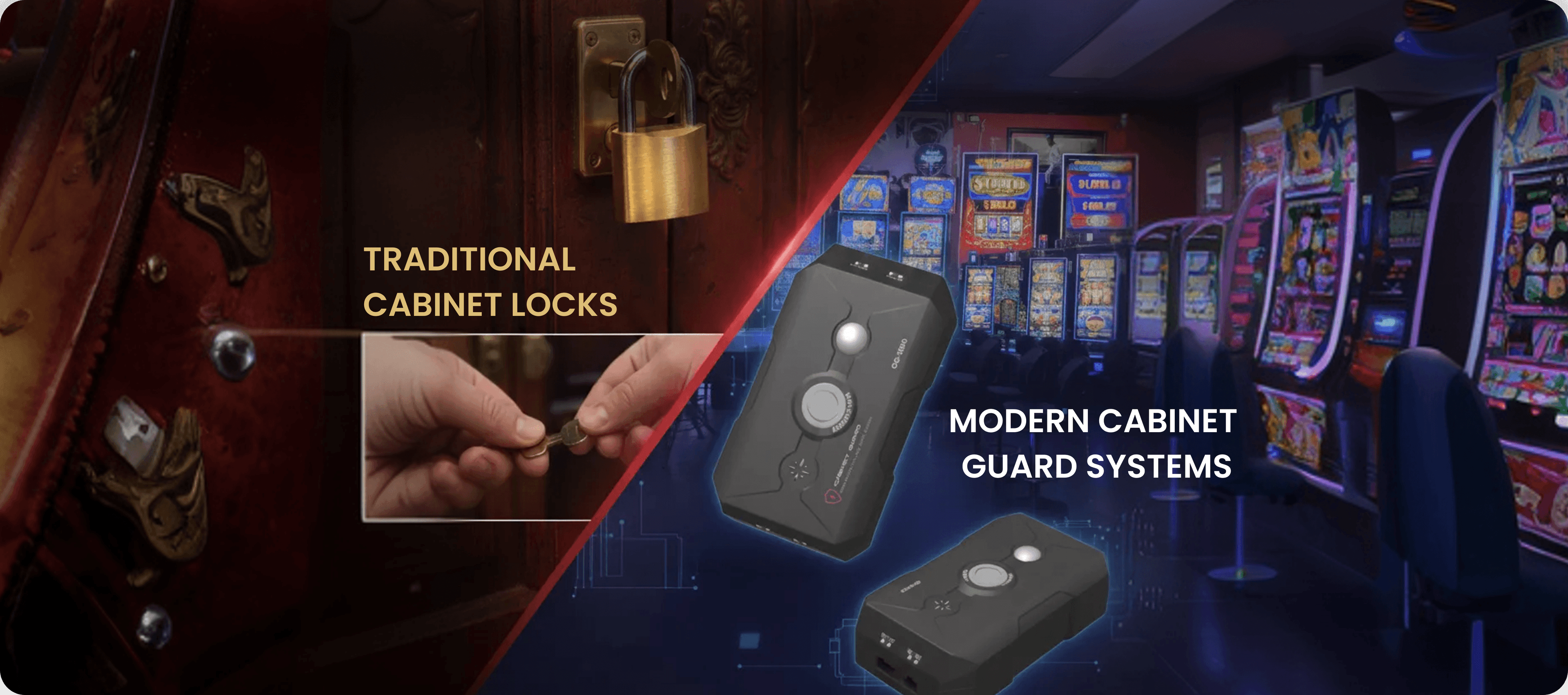
A hardwired system like the CG-1000 fires a 100+ dB siren the moment a cabinet door opens without an authorized keyfob touch, no matter how that door got opened. Picked, duplicated key, pried, it doesn't matter. The circuit only cares that the door moved. That single design detail is what actually changes the risk calculation for someone standing in front of the cabinet: a thief who suspects an alarm is present will often choose a different target, whether or not they can see anything different about the door.
The upgrade isn't a stronger lock.
It's removing the question of who has a key from the equation entirely.
Because once a key stops being the thing standing between someone and the cabinet, the whole key-control problem stops being yours to track.
How the Wiring Actually Works
The mechanics behind that are straightforward. The CG-1000 wires into the cabinet's existing door switch circuit through SW-IN / SW-OUT. It uses spring-cage terminals for that connection, which hold up better under a busy route's wear than screw posts. It also runs on 12–24V AC/DC power pulled directly from the machine, so there's no separate power brick to install or lose.
If someone cuts power before touching the door, the alarm stays armed anyway, so the workaround doesn't work. Technicians still get in without setting anything off. An authorized keyfob touch drops the unit into quiet service mode for a collection or repair, and the mechanics of how that actually holds up in the field are worth reading if you're weighing this against a lock-only approach.
If You're Working a Specific Machine Type
Vending and ATM cabinets each carry their own wiring quirks that go beyond what a generic lock-versus-alarm comparison covers. A vending cabinet's coin mech and bill validator sit close to the door and take the brunt of any prying, which changes what actually needs protecting inside a vending route. An ATM cabinet usually has two separate zones worth thinking about: the upper logic compartment and the lower cash vault. The mechanics differ enough that it's worth reading before you plan vending security or atm security upgrades machine by machine.
If you're running a genuinely mixed route, the key-control problem above applies the same way to every cabinet type. What changes is the wiring, not the underlying issue.
If you're mapping out a phased cabinet lock replacement as part of a broader cabinet security plan for your route, reach out and we'll walk through the sequencing with you.