
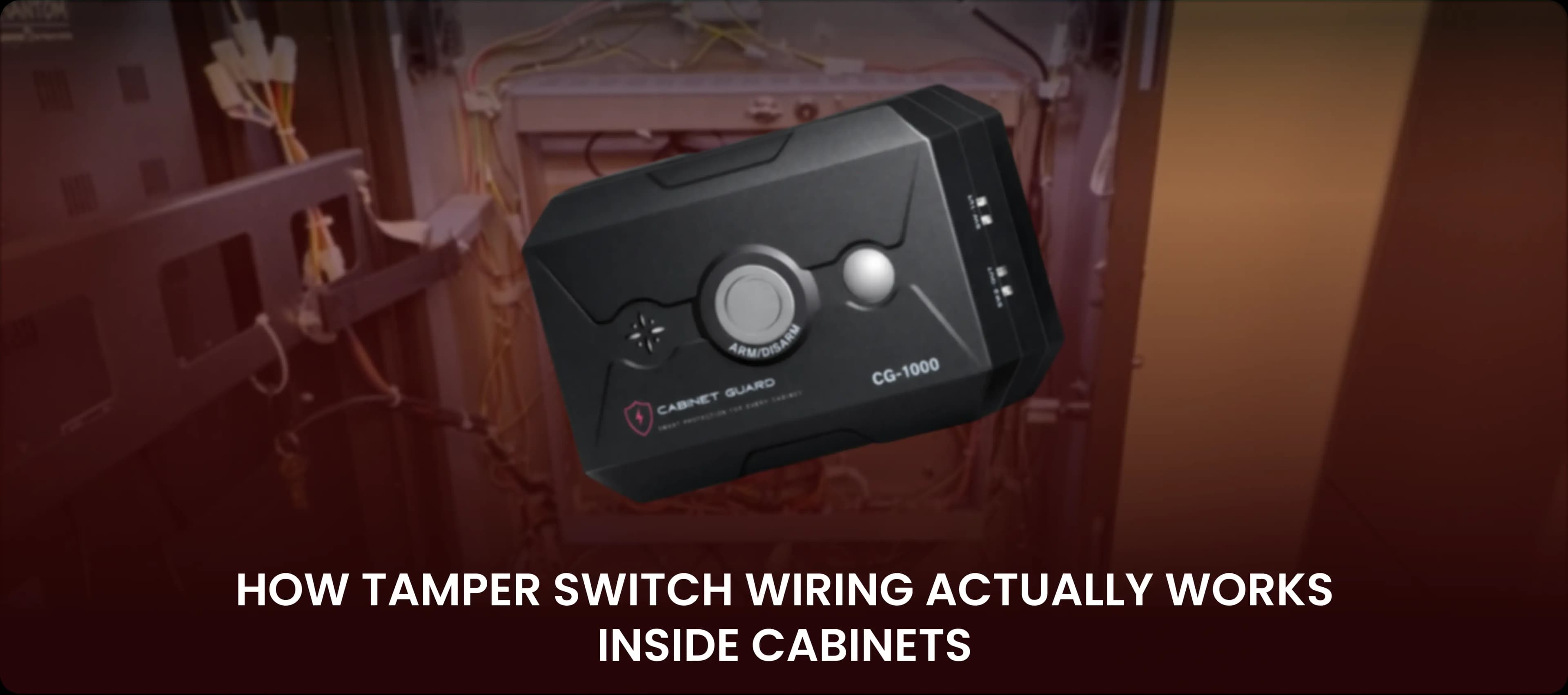
How Tamper Switch Wiring Actually Works Inside Cabinets
Apr 15, 2026
A tamper switch is more than just a trigger; it is the binary supervisor of your machine’s physical integrity. In the field, the difference between a secure location and a 2 AM emergency service call usually comes down to the copper. If you aren’t familiar with the electrical logic of tamper switch wiring, you aren't just risking a break-in; you are risking the reliability of your entire route.
Understanding the "how" and "why" of the circuit is essential for any operator looking to move past basic locks and into active defense.
TL;DR: Technical Essentials of Tamper Switch Wiring
- Normally Closed (NC) logic is the industry standard for fail-safe security.
- Wired systems offer superior reliability and signal noise reduction over wireless.
- Use stranded wire vs solid core to survive constant machine vibrations.
- The CG-1000 uses push-in wire connectors to simplify series loop wiring.
- Proper grounding prevents ground loops and interference with game logic boards.
The Anatomy of the Perimeter: What is a Tamper Switch?
In the context of a gaming or amusement cabinet, what is a tamper switch? At its core, it is a specialized sensor designed to detect the movement of a door, panel, or enclosure. Unlike a standard light switch, a tamper switch is built to be "supervised," meaning the system knows if the switch is active, bypassed, or if the wire has been cut.
Magnetic vs Mechanical Switches
Choosing the right sensor depends on the cabinet geometry. Magnetic vs mechanical switches is a common debate among technicians. Mechanical plunger switches are rugged and provide a physical "click" that confirms engagement, making them ideal for heavy main doors.
Conversely, reed switch installation is preferred for tight spaces or sensitive areas like bill validator doors. These magnetic sensors have no moving parts to wear out, but they require precise alignment to maintain a closed circuit. Regardless of the type, both function as the "eyes" of your tamper protection strategy and are the foundation of operator-grade hardware standards.
The Logic of the Loop: Normally Closed Circuits
Most professional security hardware, including the Cabinet Guard’s CG-1000, operates on a normally closed tamper switch logic. In this configuration, electricity flows through the switch when the door is closed.
Fail Secure vs Fail Safe
This is a critical distinction in security engineering. In a fail secure vs fail safe environment, we prioritize the integrity of the loop. If a thief cuts the 18-gauge alarm wire to "disable" the alarm, the circuit breaks. To the CG-1000, a cut wire looks exactly like a pried door. The siren triggers immediately. This "supervised loop" is why wired is better than wireless; you cannot "jam" or "spoof" a physical broken circuit as easily as a radio signal. This is a primary reason why DIY alarms fail in high-stakes environments.
Physical Wiring Standards for the Route
Field conditions are brutal. Machines vibrate, doors are slammed, and heat builds up. Using the wrong materials leads to brittle connections and ghost triggers.
Selecting Your Conductor
For power runs, such as 24V AC transformer wiring or connecting a DC power jack wiring source, an 18-gauge alarm wire is standard to handle the current without voltage drop. For the actual sensor loops, a 22/2 alarm wire is often sufficient.
However, we always recommend stranded wire vs solid core. Solid core wire is prone to "work hardening" and will eventually snap under the constant micro-vibrations of a cooling fan or a high-traffic game room. Stranded wire remains flexible and maintains circuit continuity, testing results over years of service. Proper wire selection is the first step in standardizing your route for long-term profit.
Shielding and Noise
In modern skill games, electromagnetic interference (EMI) is a real threat. Using a shielded security cable for your tamper loops helps with signal noise reduction, ensuring that the high-frequency "noise" from a switching power supply doesn't trick your alarm into thinking a door just opened.
Step-by-Step: How to Wire a Tamper Switch
When you are ready to install, the goal is a clean, repeatable process. The CG-1000 simplifies this with an architecture designed by operators who have spent years in the back of cabinets.
- Mount the Sensor: Ensure your plunger or reed switch is positioned where it cannot be reached by a "shim" or wire through the door gap.
- Establish the Series Loop: If you have multiple doors (Main, Coin, Bill Validator), you must wire them in a series. This means the wire goes into the first switch, out of the first, into the second, and so on.
- Utilize Terminal Block Wiring: Avoid wire nuts or "electrical tape specials." The CG-1000 features push-in wire connectors (SW-IN / SW-OUT). Strip your wire, push it in, and the spring-cage terminal locks it in place. This method is a pillar of any professional installation SOP.
- Integrate Visuals: Use the LED indicator wiring outputs to mount a status light on the cabinet exterior. This tells your tech the system is armed without them having to open the door.
Power and Grounding Logic
Whether you are using a 24V AC transformer wiring setup from the cabinet's main power or a dedicated 12V DC brick, your grounding must be clean. Be careful with chassis ground vs signal ground. Always ground your alarm system to a dedicated ground bus to avoid "ground loops" that can cause hum in the game's audio or resets on the logic board.
The Modern Standard: Out with the Old
Many older machines still rely on outdated tech. A mercury switch replacement project is often the first step in a route-wide security upgrade. Mercury switches are sensitive to floor vibrations and are environmentally hazardous. Replacing them with a modern NC plunger and a CG-1000 ensures your wiring protection is up to date, and your machines stay online.
By focusing on a standardized tamper switch wiring diagram across your entire route, you reduce the "learning curve" for your technicians and ensure that every machine is defended by a supervised, hardwired perimeter. This level of technical oversight is how savvy owners prevent internal access risks and stop the profit bleed.
Professional Security for Professional Routes
Building a reliable route means eliminating variables. When you use field-tested hardware like the CG-1000, you are getting a system designed to handle the 12–24V AC/DC realities of the amusement industry. Stop relying on DIY fixes that cause more headaches than they solve.
Protect your revenue with a system that is built by operators, for operators.