Breaking the Sonic Barrier: Why Quiet Cabinet Alarms Fail Operators
Apr 3, 2026
When it comes to protecting a skill game route, "loud" is a relative term. In the quiet of a workshop, a small piezo buzzer might sound piercing. But the workshop is not where your machines live. Out in the field, in the middle of a Friday night rush at a Texas bar or a busy Pennsylvania truck stop, that same buzzer is effectively silent.
If your cabinet alarm is not designed to overcome the ambient noise of the location, you do not have a security system, you have background music for a thief. To truly stop machine tampering, an operator needs to understand the "noise floor" and why a high decibel alarm is a non-negotiable technical requirement. This is a core part of establishing technical security standards that actually protect your bottom line.
TL;DR: The High Decibel Reality
- The Noise Barrier: Standard alarms are often drowned out by ambient location noise.
- The Target Floor: The "Noise Floor" in gaming environments averages 75–85 dB.
- Forceful Deterrence: A 100+ dB siren is required to create a physical deterrent.
- Cabinet Muffling: Sound levels drop significantly once the siren is mounted inside a cabinet.
- Hardwired Reliability: Reliable high-volume sound requires 12–24V AC/DC hardwired power.
Understanding the Noise Floor
In the world of acoustics, the "noise floor" is the level of continuous background sound in a given environment. For a route operator, this is your primary enemy. A typical convenience store or bar floor is not quiet. Between jukeboxes, televisions, other skill game cabinets, and general crowd noise, the ambient volume regularly sits between 75 dB and 85 dB. Understanding this environment is the first step in choosing the right system for your specific route.
If your security system utilizes a standard 85 dB or 90 dB siren, you are barely cresting the noise floor. To location staff and patrons, a breach at this volume sounds like just another game effect or a distant kitchen timer. It does not demand attention, and more importantly, it does not induce panic in the person attempting the break-in. This is why a 100 decibel alarm is considered the bare minimum for professional route security.
The Physics of the Cabinet: The Muffling Effect
Many operators make the mistake of checking a siren’s specs and assuming that is the volume they will get in the field. However, once you mount that siren inside a heavy wood or steel enclosure, you immediately lose decibels.
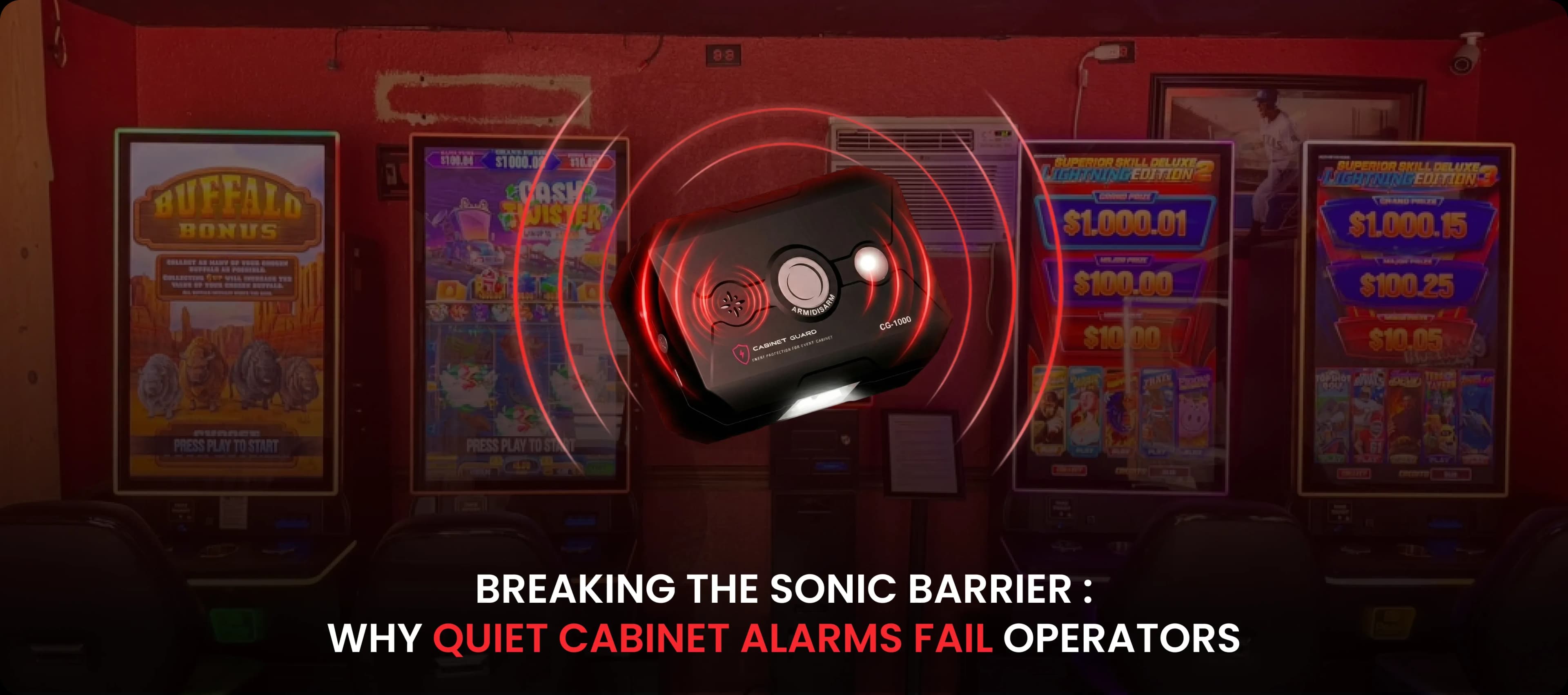
Sound is energy, and that energy is absorbed by the cabinet walls and the internal components. By the time the sound reaches the outside of the machine, it has been significantly dampened. If you start with a weak signal, you end up with a useless alert. The Cabinet Guard CG-1000 utilizes a 100+ dB siren specifically to account for this muffling effect, ensuring that the sound that actually escapes the machine is still loud enough to serve as a legitimate theft deterrent system. This level of volume is what makes a cabinet alarm truly operator-grade.
Psychological Warfare: Creating the Panic Trigger
Security is just as much about psychology as it is about hardware. A "polite" alarm allows a thief to stay calm. If they can think, they can keep working. They might try to continue the breach by working slowly or covering the siren with a rag.
A high-decibel alarm changes the chemistry of the situation. At 100+ dB, sound becomes a physical sensation. It causes an immediate spike in cortisol and triggers the fight-or-flight response. When a machine is breached, and a piercing siren fills the immediate space, the thief's only goal becomes making that sound stop. Since they cannot stop the CG-1000 without the proper iButton key, their only option is to flee. This is how you stop tampering before the cash box is compromised.
Power Requirements for Professional Sound
Producing a consistent 100+ dB siren blast requires more than a 9V battery can reliably provide over the long term. This is a common failure point for DIY or low-end systems. To maintain long-term reliability, the hardware must be hardwired. You can see how this compares to other methods in our guide on traditional locks vs modern systems.
The CG-1000 is built to handle 12–24V AC/DC power directly from the machine's power supply. This ensures that the siren has the necessary current to hit its peak volume every single time a door is opened without authorization. It also means the system adheres to the professional standards that experienced installers expect.
Staff Accountability and the "Impossible to Ignore" Rule
One of the biggest frustrations for route operators is when location staff claim they "didn't hear" a machine being tampered with. A cabinet tamper alarm that is too quiet gives the staff an excuse to ignore the problem. Failure to address this is one of the warning signs it is time to upgrade.
When you install a high-decibel alarm in your arcade security or skill game setup, you remove that excuse. The sound is loud enough that the staff wants it to stop. It forces them to get up, check the machine, and call the operator. It bridges the gap between a machine sitting in a corner and an active, protected asset. By choosing a system that prioritizes volume, you are ensuring that vending security actually stops the event.
Don't settle for "loud enough" in a vacuum. Ensure your machines are loud enough for the field.
Protecting your revenue starts with making sure a break-in is the loudest event in the room. If you are ready to upgrade your route to a field-tested, operator-designed solution that doesn't rely on quiet buzzers or flimsy wireless signals, the CG-1000 is the answer.