Layered Security for Gaming Cabinets: What Locks Miss and Alarms Catch
Jul 29, 2026
A skill game cabinet on a Missouri route had a working lock, a solid door, and still came up short one afternoon. The lock hadn't failed in any way anyone could point to. It just did the only job it was built for, which is to slow someone down, and slowing someone down isn't the same as knowing something happened. That gap is where a lot of cabinet security actually breaks down, and it's why more operators are asking about security layers instead of picking one product and calling the job done.
Gaming Cabinet Security Layers at a Glance
- Locks resist; they don't report: A cabinet lock's job ends the moment someone gets past it.
- Detection works in real time: A cabinet tamper alarm fires the instant a door opens, whether the lock held or not.
- Neither layer replaces the other: Physical resistance and electronic detection solve two different problems.
- The combination closes the gap: Adding a cabinet alarm system to hardware that's already in place turns a silent failure into an immediate signal.
- Installation doesn't have to be complicated: A hardwired alarm system can run alongside whatever lock is already on the cabinet.
What a Cabinet Lock Actually Stops
The Job a Lock Was Built For
A cabinet lock does exactly one thing. It makes access harder for anyone without a key, which is a real function and worth having. Most gaming cabinets on a route carry some version of this, whether it's a factory cam lock or something an operator added on later.
That makes sense once you think about what a lock is actually designed to do. It buys time. It doesn't buy certainty.
Where That Job Ends
Once a lock is defeated, silence follows. Nothing reports the door opening. Nothing flags that the cabinet was accessed outside a scheduled service call. The next signal an operator gets is usually a collection report coming up short, or a technician noticing something during a regular stop that wasn't supposed to happen.
A locked door and an opened door look identical from across the room. That's not a flaw in the lock. It's just outside what a lock was ever built to do, and it's the exact reason physical hardware alone leaves a blind spot.
For the deeper mechanical side of what actually resists tampering, we've covered that in more detail elsewhere.
What Electronic Detection Adds That a Lock Can't
Real-Time vs. After the Fact
This is the actual difference between the two layers. A lock resists in the moment someone tries it. A tamper alarm system reports in the moment someone succeeds. One is about prevention, the other is about immediate awareness, and mixing the two up is where a lot of route security planning goes wrong.
A cabinet door alarm doesn't care whether the lock held for ten seconds or ten minutes. It only cares about the door itself. The moment that circuit breaks, the alarm fires.
Why the Trigger Doesn't Care How the Door Was Opened
It doesn't matter whether the lock was picked, drilled, or just left unlatched by mistake during a service call gone sideways. A door-contact trigger doesn't ask how the door opened. It only knows whether the door is closed or it isn't.
That's a different kind of coverage than a lock alone can offer.
It doesn't stop the attempt.
It ends the uncertainty about whether an attempt happened at all.
Getting the wiring right also cuts down on nuisance trips, something we get into more in our guide to reducing false alerts.
Gaming Cabinet Security Layers: Why the Combination Matters
What Physical Alone Misses
A lock, even a good one, has no way to signal failure. If someone works around it using a method the manufacturer never anticipated, that failure stays invisible until someone happens to notice it later, sometimes days later.
What Electronic Alone Misses
An alarm with nothing physical in front of it doesn't slow anyone down first. Casual attempts that a solid lock would have discouraged now get a real shot at reaching the door contact at all, since there's nothing there making the attempt harder in the first place.
Commercial break-ins move fast. According to Talius's Annual Commercial Break-In Protection Report, the average commercial break-in takes under four minutes from start to finish. That's not much runway for a lock working alone, and it's exactly why the second layer has to respond immediately rather than get discovered on the next stop.
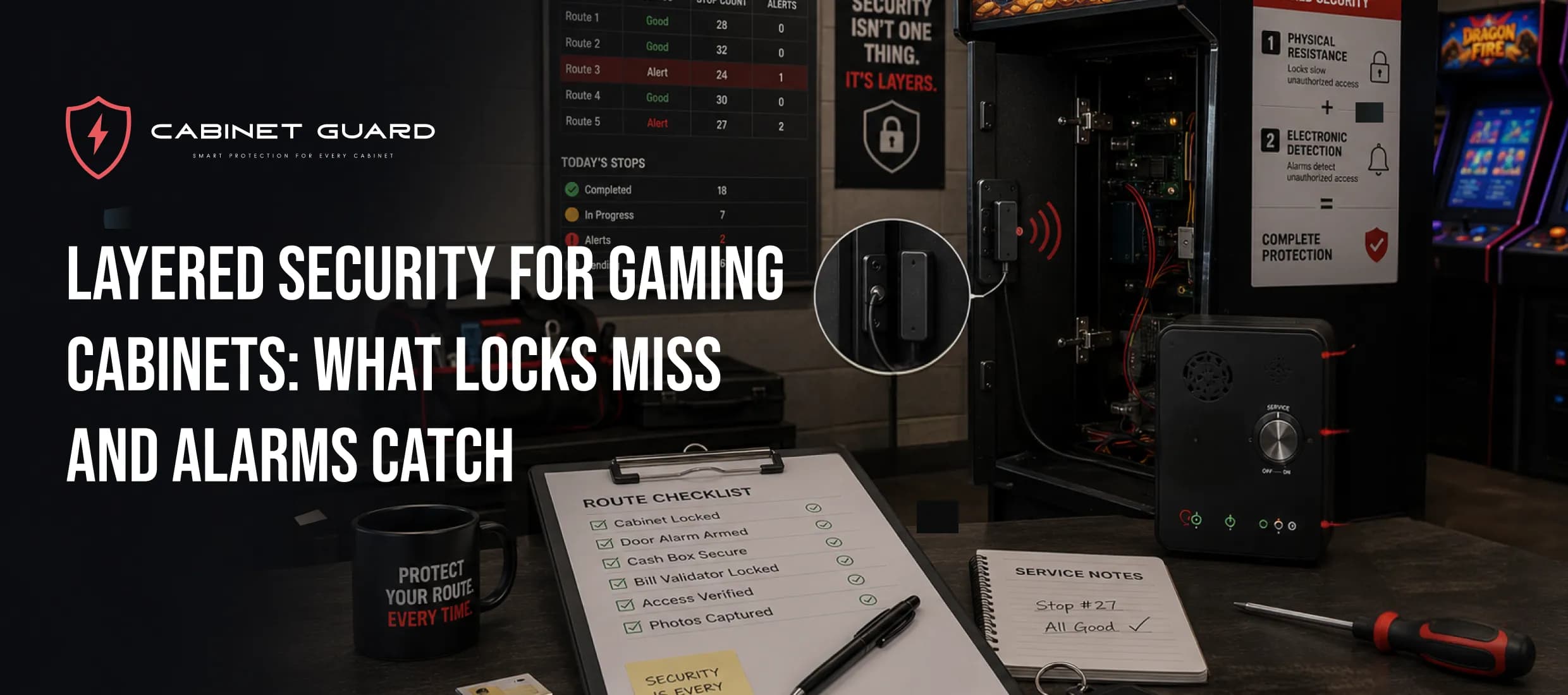
Think of the lock as the first protection layer and the alarm as the second. A lock and alarm pairing covers two separate risks, not the same risk twice. A security layer built only from resistance has no way to report failure. A door alarm system with no resistance in front of it has nothing slowing down the easy attempts. Security layers, plural, means both jobs get handled, not one job handled twice.
For the fuller case on why hardwired detection holds up better long-term, see why hardwired detection holds up.
What This Looks Like on an Actual Route
The thing is, most operators don't start thinking seriously about the second layer until after the first one has already been tested and found lacking.
A Route Check, Not a Crime Scene
Picture two versions of the same stop. In the first, a technician arrives for a scheduled service call, and everything checks out the way it should. In the second, an operator gets a page because a door contact tripped on a stop with no service call logged for that day. Nothing about a clock explains the difference between these two visits. What explains it is whether the door opening matched something that was supposed to happen.
What Changes When Both Layers Are Already in Place
With a lock resisting the easy attempts and a hardwired alarm system flagging the ones that get through, an operator finds out about the second scenario right away, not on the next scheduled stop. Many thefts happen even when you are present, even during broad daylight, which is exactly why waiting for a scheduled visit to catch a bad one isn't good enough on its own.
Arcade locations carry their own wrinkles worth a look, covered in arcade-specific security details.
This isn't about picking a side.
It's about which job needs doing when.
A lock buys time. An alarm buys certainty. A gaming cabinet route needs both, not a stronger version of just one.
Where a Door-Contact Alarm Fits Into That Stack
What the Door-Contact Layer Actually Adds
This is where a product like the CG-1000 fits in as the electronic half of the stack. It's a wired alarm, built to run standalone. It doesn't depend on WiFi, an app, or any cloud connection to work. It connects to the existing door circuit through SW-IN and SW-OUT wiring.
Power comes in across a 12–24V AC/DC range, wide enough to work as a 12v security system on older wiring or scale up to 24V setups on newer cabinets. Optional battery backup keeps the alarm armed if power gets interrupted. The siren itself only fires when the door contact trips, not from a power cut alone.
The alarm doesn't replace the lock already on the cabinet. It sits behind it, covering the one scenario a lock can't report on its own, the door actually opening without authorization.
Not every alarm on the market is built the same way. We go deeper on what makes an alarm operator-grade in a separate piece.
Keeping the Electronic Layer Simple to Install
Adding an electronic layer to hardware that's already in place shouldn't mean re-engineering the cabinet. Spring-cage plug-and-play terminals are designed to simplify installation and reduce unnecessary wiring complexity, which matters most for operators managing dozens of stops across a route rather than just one.
The keyfob piece works like a simple keyfob security system. Authorized technician credentials manage service access on-site, and the alarm stays quiet during a normal visit. The door-contact circuit only fires when the door physically opens, so ordinary cabinet vibration has no way to trigger it by design.
For the full rundown, how service mode actually works is covered in a separate piece. If you're not sure how this fits your specific cabinets, reach out with installation questions and we'll walk through it.
Check the full product specs before deciding what fits your route.