Do Cashless Vending Machines Still Need Cabinet Security?
Aug 12, 2026
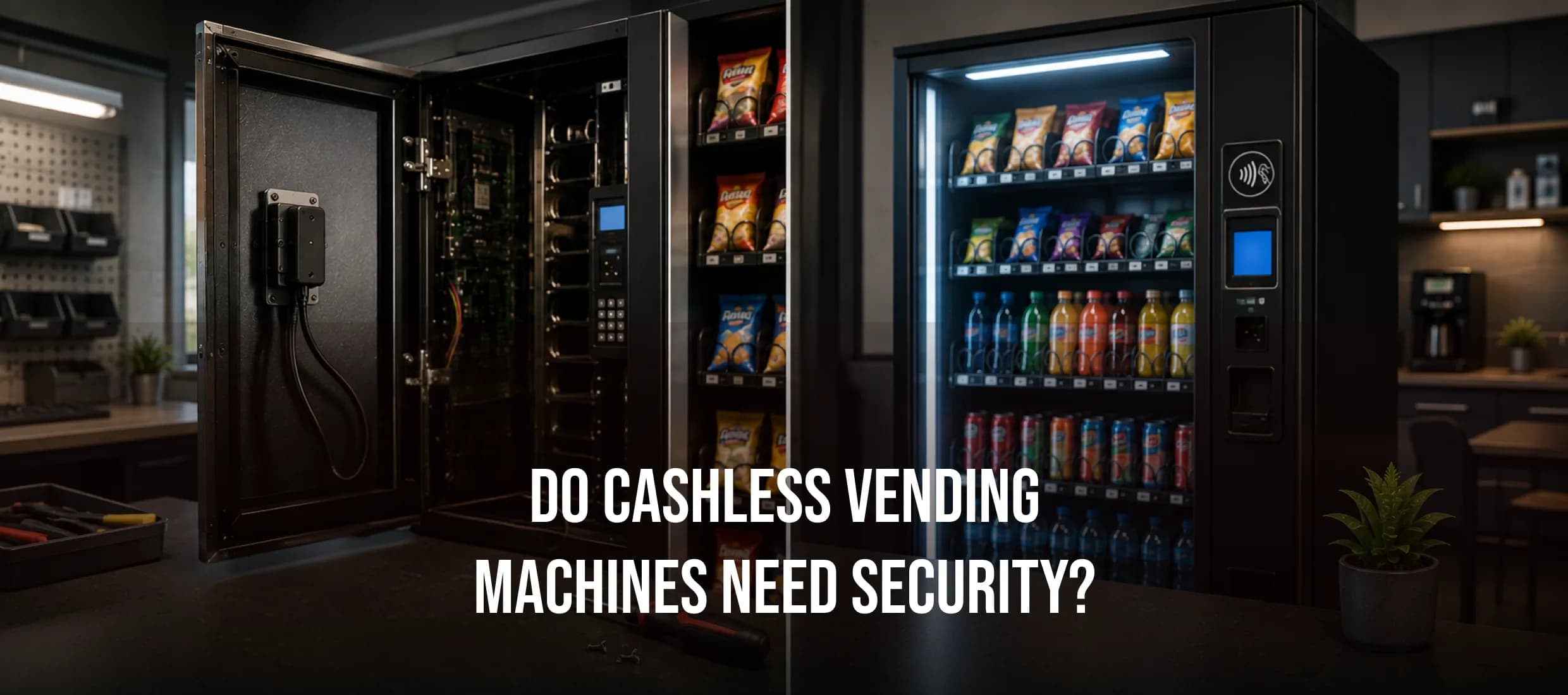
A vending machine that only takes card or mobile payments looks like a lower target than one stuffed with coins and bills. That's the logic behind a question coming up more often as cashless vending machine adoption spreads across routes: if there's no cash sitting behind the door, does the cabinet still need the same level of protection?
Less cash changes part of the math.
It doesn't change all of it.
Cashless Vending Machine Security: The Short Answer
- Cash isn't the only target: Card readers, control boards, and stocked inventory hold value whether or not cash sits behind the door.
- Forced doors cost the same either way: Downtime, dispatch calls, and parts replacement don't care what payment method the machine ran.
- Vandalism doesn't need a motive tied to cash: A real share of vending machines get hit by theft or vandalism every year, cashless or not.
- A door-contact alarm doesn't check what's inside: It fires the moment the door opens without authorization, regardless of the payment hardware behind it.
- Mixed fleets need one security standard: Running cash and cashless units on the same route calls for consistent cabinet protection across both.
Why Operators Assume Cashless Machines Are Lower Risk
Picture a mixed route: a handful of older bill-accepting machines running alongside newer card-only units installed over the past year. An operator doing rounds notices something. The older machines get pried more often. The newer ones, less so.
That pattern looks like evidence.
The thing is, a prybar doesn't know what payment method sits behind a door before it goes to work. Someone forcing a cabinet is testing whether it opens, not checking what's inside first. A card-only machine sitting in a dim corner with a weak lock is still an easier target than a cash machine that's bolted down and well-lit.
Operators have been asking what alarm options actually exist for vending machines generally for a while now. The cashless version of that question just adds one more variable that turns out to matter less than expected.
The pattern isn't proof cashless machines are safe.
It's proof forced entry usually targets whichever cabinet looks easiest that day.
What's Still Inside the Cabinet, Card Reader or Not
The Card Reader Itself Is Worth Protecting
Swap a coin mechanism and bill validator for a card reader, and the cabinet doesn't get simpler to break into. It gets a different component sitting behind that same door, and one that isn't cheap to replace.
The reader itself costs money. So does the wiring that connects it to the machine's control board, and the mounting hardware that usually takes damage right alongside it when a door gets forced. None of that shows up as cash lost on an incident report. It still shows up as a bill.
Inventory and Product Loss Doesn't Care How the Machine Got Paid
Card readers cut down on cash sitting inside a cabinet. They don't cut down on what's stocked inside it. Snacks, drinks, and whatever higher-value inventory a location carries are still sitting behind the same door, cashless or not.
Vandalism and theft affect a real share of vending cabinets regardless of payment type. Market Reports World's vending machine market report puts that figure at 12% of units annually, a number that includes plenty of incidents where cash was never the target at all: someone after product, someone doing damage with no clear motive, someone just testing whether the door holds.
Removing cash from the equation removes one motive, not every reason a cabinet gets targeted.
The Cost of a Forced Door Doesn't Change With the Payment Method
A forced cabinet door sets off the same sequence no matter what's behind it. Someone has to notice the unit is down. A technician has to get dispatched. Parts have to get sourced, and the cabinet sits empty of revenue the entire time it's out of service.
A single successful machine break-in can cost operators $10,000+ when stolen cash, cabinet damage, downtime, and service response are combined. On a cashless unit, the cash portion of that total shrinks. The damage, downtime, and dispatch portions don't move at all.
The real cost of unplanned downtime tends to run higher than operators expect once parts lead time and a missed collection window get counted together. That math doesn't care whether the machine that got hit ran a cash drawer or a card terminal.
Where a Door-Contact Alarm Fits on a Cashless Route
This is where a hardwired door-contact alarm actually earns its place on a cashless route. It was never built around what's sitting inside the cabinet. It's built around whether the door itself opens without authorization.
What Actually Trips the Alarm
The CG-1000 doesn't check what payment method a machine runs before deciding whether to fire. It uses a door contact wired through SW-IN and SW-OUT terminals, the same setup that works across cash machines, card-only machines, and everything in between on a mixed route.
Open the door without putting the unit into service mode first, and the 100+ dB siren fires. It doesn't matter if there's a stacker full of bills behind that door or an empty compartment and a card reader.
Staying Armed Between Service Stops
The technician or collector carries the keyfob to put the unit into service mode for the duration of a scheduled stop. Without it, the door contact treats the opening as unauthorized, whether the machine still runs a bill validator or switched to card-only entirely.
If cabinet power is interrupted, internal backup power keeps the alarm system armed so unauthorized cabinet access can still trigger the alarm. We go deeper on how battery backup holds up in a dedicated piece, but the short version is that a power cut doesn't open a window.
Installing a system like this on cabinets that weren't originally wired the same way is where spring-cage terminals make the retrofit easier, since they don't require the same connection work older screw terminals do.
Full CG-1000 specs run on 12–24V AC/DC, which covers most cabinet types already in service across a mixed route.
Standardizing Security Across a Mixed-Payment Fleet
Most routes don't flip from cash to cashless overnight. They run both for months, sometimes years, unit by unit and location by location as budgets and equipment cycles allow.
Treating cashless machines as a lower security tier during that stretch creates a real gap. A route with alarms on the cash-handling units and nothing on the card-only ones just moved the exposure instead of closing it.
Standardizing across a mixed fleet makes sense precisely because forced entry doesn't discriminate by payment type. It's built for broad compatibility across most cabinet types, which is what makes that kind of consistency possible on a route that's mid-transition rather than fully converted either way.
If your route is running a mix of cash and cashless machines right now, the wiring questions usually come up unit by unit rather than all at once. Reach out about your setup, and we can walk through what fits across the mix you're actually running.